If you’ve been comparing inositol supplements for PCOS (now called PMOS), you’ve run into a similar issue most women do: one label says myo-inositol, another says D-chiro-inositol, and a third lists both at a 40:1 ratio. There’s also usually not a detailed explanation of what that means or which one you actually need. Even if you have heard the hype behind the ingredients, the confusion can make you put the bottle back on the shelf and not think twice.
I’m Tallene, a Registered Dietitian who specializes in PMOS and has the condition myself. I’ve spent about a decade helping women decide what supplements are and which ones can actually help them. But there’s one pattern that I see constantly: a woman takes a high dose of D-chiro-inositol or myo-inositol alone because a label or an article told her it was “the stronger one.”
So, let’s break it ALL down. I’ll talk about what myo-inositol and D-chiro-inositol are, how each one connects to insulin sensitivity and ovarian function, and what the research says about using them together. I’ll explain where the 40:1 ratio comes from and what studies have found about it because when it comes to managing your PMOS, you deserve clarity, not confusion.
Heads up! Polycystic ovary syndrome (PCOS) got a name change! It’s now called polyendocrine metabolic ovarian syndrome (PMOS). You’ll see me use both interchangeably as the community adjusts to the change.
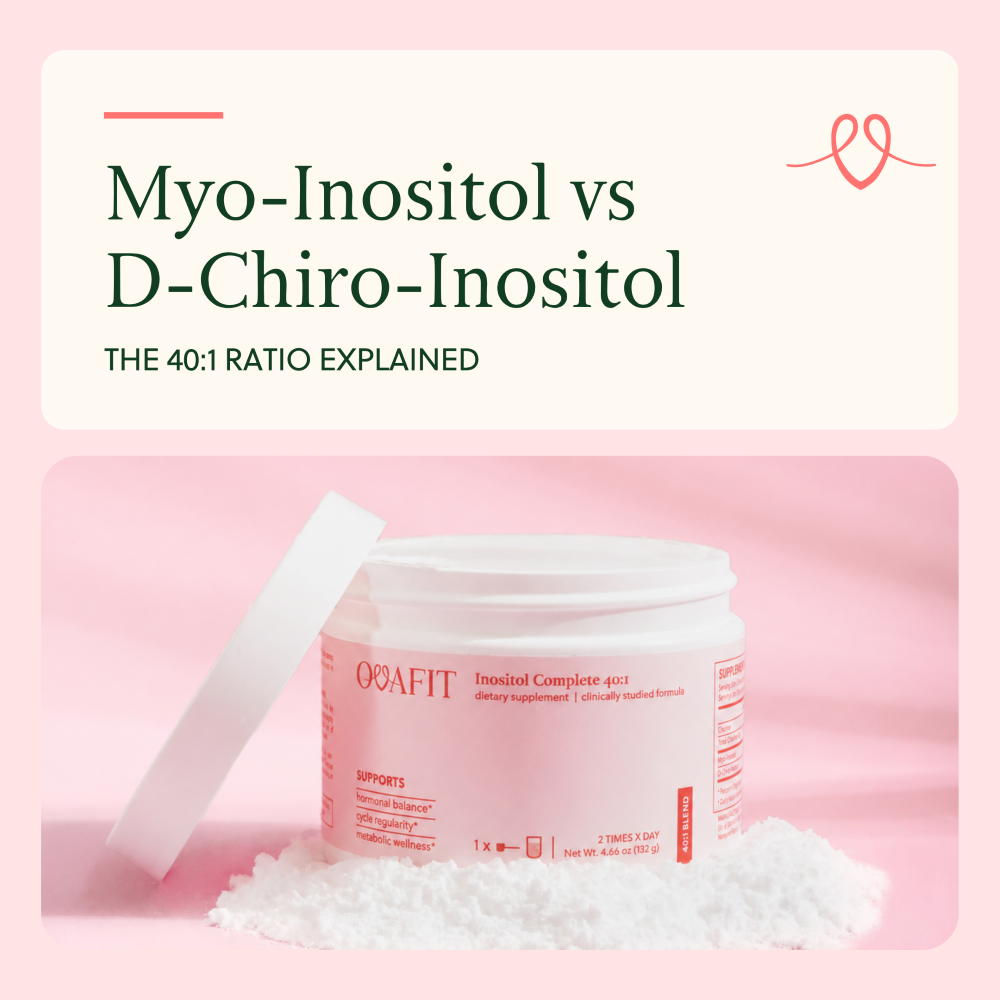
Myo-Inositol vs D-Chiro-Inositol: What’s the Difference?
Both myo-inositol and D-chiro-inositol are naturally occurring forms of inositol that help your body respond to insulin. But they do different jobs in different tissues.
When insulin sends a signal to your cells, both forms of inositol help carry that message along. This is part of how they support healthy insulin sensitivity, but their roles aren’t the same. Myo-inositol is the most abundant form found naturally in your body. It’s especially important in the ovaries, where it helps support follicle development and egg quality. It also plays a role in how your ovaries respond to follicle-stimulating hormone (FSH).
D-chiro-inositol, on the other hand, is more involved in how your body stores glucose, particularly in your muscles, liver, and fat tissue. It also plays a role in ovarian testosterone production, which is important to understand! Too much D-chiro-inositol in the ovaries may contribute to higher testosterone levels.
That’s why the balance between these two forms matters for women with PMOS. Even though they both support insulin signaling, taking more of one isn’t necessarily better than getting the right balance of both.
| Myo-Inositol | D-Chiro-Inositol | |
| What It Is | The most common form of inositol in your body | A form of inositol your body makes from myo-inositol |
| Where It Works | Throughout the body, including the ovaries | Throughout the body, including the muscles, liver, and fat tissue |
| What It Helps With | Insulin signaling, ovarian function, and egg development | Insulin signaling, glucose storage, and androgen regulation |
| Natural Balance | Usually found in higher amounts than D-chiro-inositol | Usually found in smaller amounts than myo-inositol |
Your body naturally has more myo-inositol than D-chiro-inositol, but the balance depends on where you look. That 40:1 ratio is especially important because it’s the basis for one of the most commonly studied inositol supplement combinations for women with PMOS.
What Is Myo-Inositol?
Myo-inositol is a naturally occurring sugar alcohol and the most common form of inositol in the body. Your body makes it, you get it from foods, and it functions as a second messenger inside your cells. Basically, it’s the middleman that helps communicate insulin’s message once insulin binds to its receptor. When that signaling works well, your cells respond to insulin more efficiently, which is especially important for anyone managing insulin resistance.
But myo-inositol also has an important role in the ovaries beyond how it’s involved with insulin. It helps your ovaries respond to follicle-stimulating hormone (FSH), which plays a major role in egg development. More specifically, myo-inositol is involved in FSH signaling with the granulosa cells that surround a developing egg. Research suggests that having enough myo-inositol in the fluid surrounding the egg may help support follicle development and egg quality.
This is one reason why myo-inositol gets so much attention in fertility research, particularly for women with PMOS. But, what have searchers actually found?
Some studies involving assisted reproduction suggest that myo-inositol supplementation may reduce the amount of FSH needed during ovulation stimulation. Other research has looked at whether it can help improve insulin sensitivity, support more regular ovulation, and influence egg quality in women with PMOS.
The results are promising in some areas, but they’re not equally strong across the board. Myo-inositol is one of the most studied supplements for PMOS, and there’s still a lot we’re learning about what it can and can’t do.
What Is D-Chiro-Inositol?
D-chiro-inositol is another form of inositol that helps your body respond to insulin. Your body actually makes it from myo-inositol through a process involving an enzyme called epimerase. How much myo-inositol gets converted depends on the tissue and how your body responds to insulin.
D-chiro-inositol has been studied for insulin resistance and for PMOS because of its role in glucose storage and insulin-related testosterone production in the ovaries. It’s an important part of how your body processes glucose. That said, researchers have also found that taking too much D-chiro-inositol on its own may have unwanted effects on egg quality.
And this is where dosage becomes especially important. In one study involving women going through fertility treatment, researchers found that higher doses of D-chiro-inositol were associated with poorer ovarian responses. Women receiving higher doses needed more FSH during ovulation stimulation, and researchers observed fewer mature eggs and lower-quality eggs in certain treatment groups.
Animal studies have made similar points. In one study involving mice, high doses of D-chiro-inositol were linked to changes in ovarian tissue, increased testosterone levels, and reduced aromatase, an enzyme involved in estrogen production.
Of course, findings from animal studies don’t always translate directly to humans. And these results don’t mean D-chiro-inositol is harmful at every dose. They do suggest that taking more isn’t necessarily better, especially when you’re trying to support ovulation and egg quality.
That’s one reason researchers have paid so much attention to the balance between myo-inositol and D-chiro-inositol rather than just increasing the amount of D-chiro-inositol on its own.
How Do Myo-Inositol and D-Chiro-Inositol Work Together?
So if myo-inositol supports ovarian function and D-chiro-inositol plays a bigger role in glucose storage, you might wonder why you couldn’t just take a larger dose of both.
The reason is that these two forms of inositol are connected. Your body uses an insulin-dependent enzyme called epimerase to convert myo-inositol into D-chiro-inositol. How much gets converted depends on the tissue and its response to insulin.
This is where something called the ovarian paradox comes into the picture. In women with PCOS (PMOS), insulin resistance can affect tissues like the muscles and liver. But the ovaries are still sensitive to insulin, even when the rest of the body isn’t responding as well.
So, while your muscles and liver may struggle to respond to insulin, your ovaries can continue responding to higher insulin levels. I know, confusing and frustrating. Researchers believe this may cause the ovaries to convert more myo-inositol into D-chiro-inositol than they normally would. Over time, that could leave the ovaries with less myo-inositol available for FSH signaling and healthy egg development.
And because myo-inositol is involved in both insulin signaling and ovarian function, that imbalance may be especially important for women with PMOS who are struggling with irregular ovulation. Researchers have even measured the differences in these two forms of follicular fluid. In one study, the myo-inositol to D-chiro-inositol ratio was around 100:1 in healthy participants but dropped to 0.2:1 in women with PMOS who also had higher insulin resistance and insulin levels. That’s a pretty significant difference!
It helps explain why researchers are interested in restoring a healthier balance between the two forms rather than simply increasing D-chiro-inositol. Of course, though, the ovarian paradox is still being studied. It’s a useful explanation for what may happen in some women’s ovaries, but it’s not one-size-fits-all.
Why Is the 40:1 Ratio Used?
Now that we’ve covered how myo-inositol and D-chiro-inositol work together, let’s talk about the ratio you’ll probably see mentioned most often: 40:1. This combination has been studied for its potential effects on insulin sensitivity, ovulation, and other metabolic and reproductive markers. But what does 40:1 actually mean, and why do researchers use it?
What Does the 40:1 Ratio Mean?
A 40:1 ratio means you’re getting 40 parts myo-inositol or every 1 part D-chiro-inositol. That number comes from the approximate neutral ratio of these two forms in blood plasma. In follicular fluid, the proportion of myo-inositol is typically even higher, around 100:1.
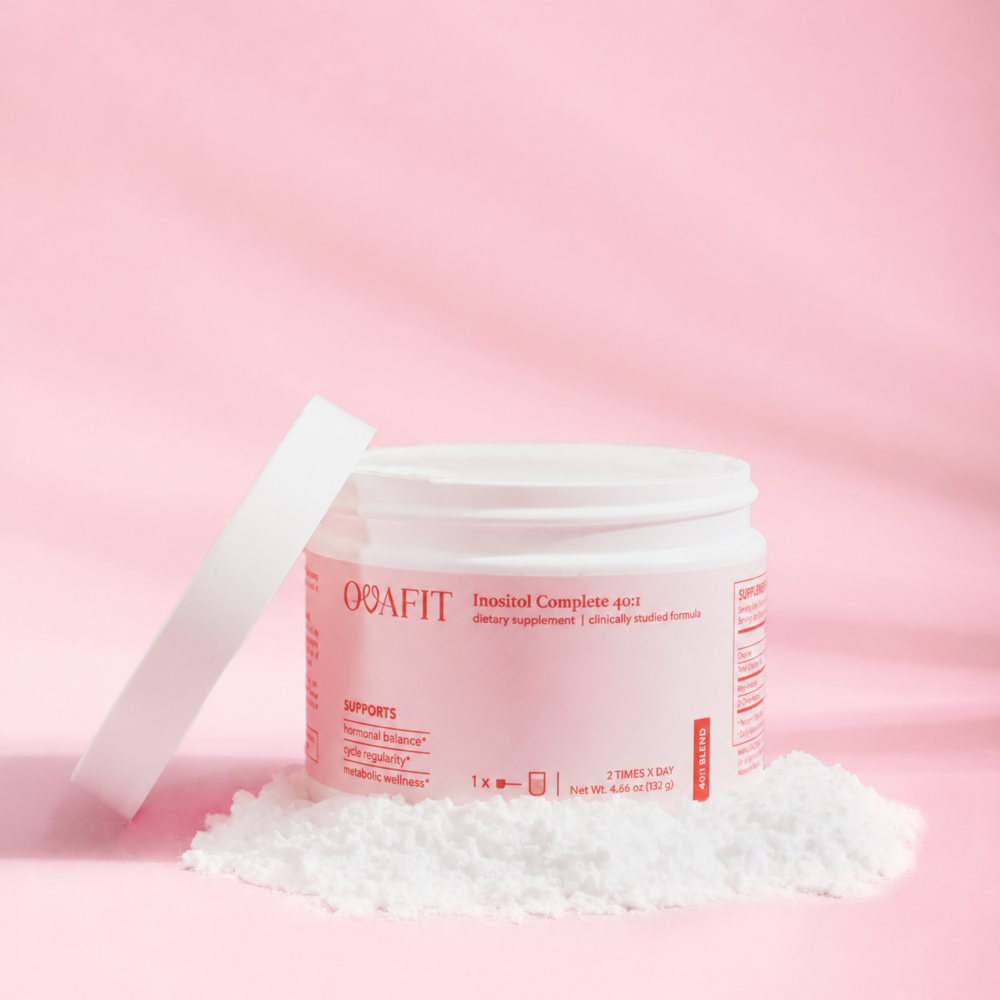
The idea behind 40:1 inositol supplementation is to provide both forms in a proportion similar to what’s naturally found in circulation. It’s also why I chose this ratio for Ovafit’s Inositol Complete 40:1. I wanted a formula based on a combination that’s been clinically studied in women with PMOS, rather than just adding more D-chiro-inositol.
That doesn’t mean the ratio is guaranteed to work for everyone, though. Let’s look at what the research says:
What the Research Says About the 40:1 Ratio
One of the studies you’ll see referenced the most was published by Nordio and colleagues in 2019. The researchers looked at 56 women with PCOS (PMOS) and compared seven different inositol formulations. These included D-chiro-inositol alone and combinations with myo-inositol to D-chiro ratios of 1:3.5, 2.5:1, 5:1, 20:1, 40:1, and 80:1.
Of the combinations tested, the 40:1 ratio produced the strongest results for restoring ovulation and improving the hormonal and metabolic markets in the study. The researchers also found that combinations containing higher proportions for D-chiro-inositol tended to be less effective for reproductive outcomes.
Earlier research in mice found a similar pattern. When researchers compared ratios of 5:1, 20:1, 40:1, and 80:1, the 40:1 combination produced the greatest improvement in PCOS-related features they measured. Other studies have also explored whether combining myo-inositol and D-chiro-inositol at 40:1 may offer benefits beyond myo-inositol alone. Some have reported improvements in LDL cholesterol, triglycerides, and the HOMA-IR, a measure used to estimate insulin resistance.
Is the 40:1 Ratio Right for Everyone?
Not necessarily! While the 40:1ratio is a popular option for women with PMOS, your individual needs still matter.
For example, if you’re focused on supporting ovulation and egg quality, the research surrounding myo-inositol and ovarian function may be important. If your biggest concern is supporting insulin sensitivity or managing other metabolic symptoms, your provider may want to look closer at your insulin levels, glucose levels, and overall health before recommending a supplement.
And if you’re already using other PMOS treatments, including metformin or birth control, it’s worth discussing inositol with your healthcare provider before adding it to your routine. The same goes if you’re actively trying to conceive.
If you’re interested in learning more about the formulation itself, you can read more about our inositol 40:1 supplement and why we chose this specific combination. I also have a guide to choosing the best inositol supplement for PMOS if you’re comparing different products and trying to understand what matters on the label.
And if you’re still figuring out which PMOS symptoms are affecting you most, our What’s Your PMOS Type? quiz can be a helpful place to start.
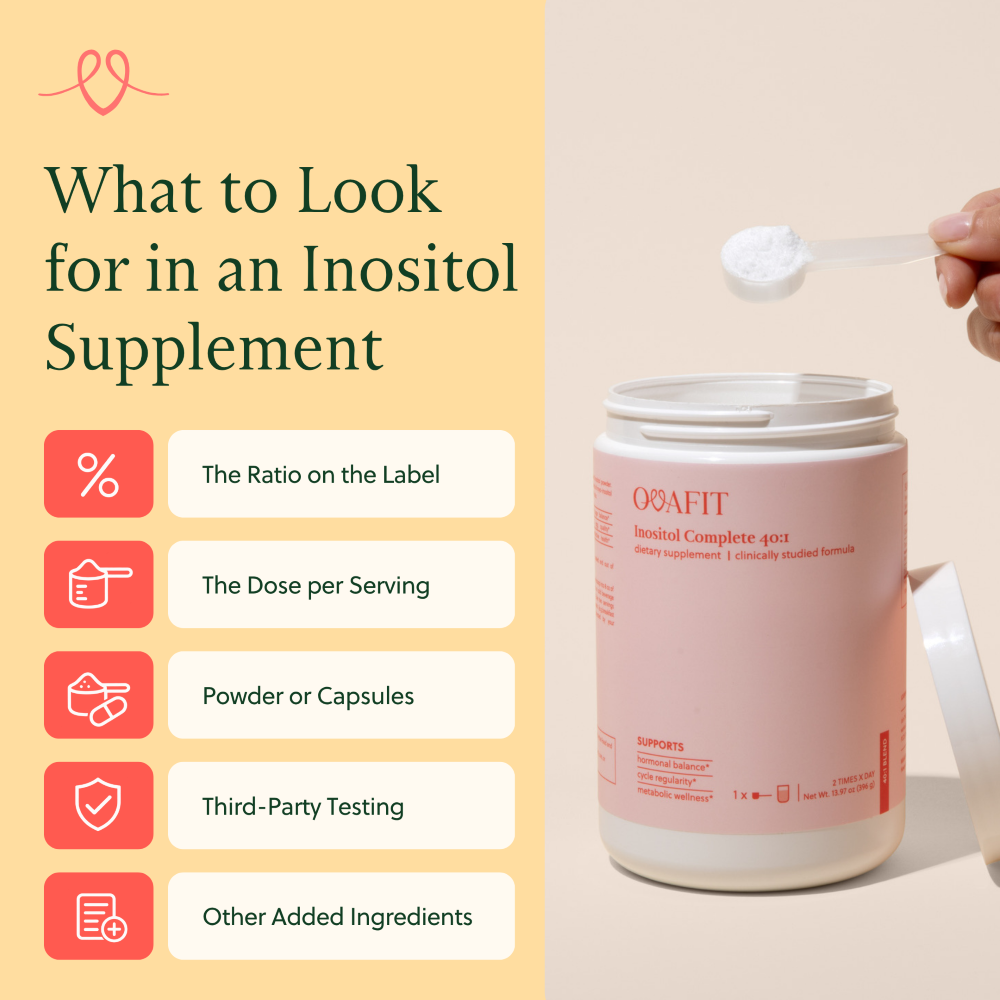
How to Choose the Right Inositol Supplement
Once you understand the difference between myo-inositol and D-chiro-inositol, comparing supplements becomes a lot less overwhelming. Here’s what I tell women who are starting inositol for the first time to actually look at:
- The ratio on the label. Look for the amount of myo-inositol compared to D-chiro-inositol. Not every supplement uses a 40:1 ratio, so knowing what you’re getting makes it easier to compare products.
- The dose per serving. Check how much total inositol you get in a serving, and how that’s split between the two forms.
- Powder or capsules. This really comes down to preference! Some women, like myself, like mixing a powder into their morning routine, while others would rather take capsules. Choose whichever option you’ll stick with consistently.
- Third-party testing. Look for brands that provide independent testing for quality, purity, and ingredient amounts. Manufacturing standards matter, too.
- Other added ingredients. Some formulas add extra vitamins, minerals, or herbal ingredients. Read the full label so you know exactly what you’re taking.
When exploring an inositol supplement for PMOS, I considered all of these details, which is why I formulated our Inositol Complete 40:1 the way I did.
And one more thing I want to remember: inositol working for someone else doesn’t mean you’ll have the same experience. PMOS affects everyone a little differently. Your insulin resistance, hormone levels, cycle patterns, and individual health can all influence what kind of support you need. You also won’t notice changes right away! Give it time and have realistic expectations.
Choose Myo-Inositol and D-Chiro-Inositol for PMOS With Confidence
The thing I want you to walk away with is this: the difference between myo -inositol and D-chiro-inositol isn’t meant to confuse you. They’re different ingredients that can work together to support your PMOS management plan. Understanding those differences is what puts you back in the driver’s seat.
Supplements support your body, they don’t replace a thoughtful plan, a gluten- and dairy-free diet, and constant communication with your healthcare provider. But when you understand the “why,” you can choose with confidence instead of guessing.
You’ve got this,
Tallene, RD
Medical disclaimer: This content is for educational purposes only and is not medical advice. It is not intended to diagnose, treat, cure, or prevent any disease or condition. Always talk with your doctor or a qualified healthcare provider before starting any supplement, especially if you are pregnant, trying to conceive, or taking medications such as metformin or birth control.
These statements have not been evaluated by the Food and Drug Administration. This product is not intended to diagnose, treat, cure, or prevent any disease.